
In a closed discussion at the Wiggin Gomes Summit following Chatham Institute rules, the point was made that:In the area of mobile games, marketing has become more important and dominant than game design innovation.The game industry can be broken down into four main areas: 3A mainframe work, long-line operations, mobile and independent games. Especially for mobile games, the label “recreation” is being questioned — in a game like Royal Match, where players usually have thousands of customs clearances, clearly beyond “recreation”.
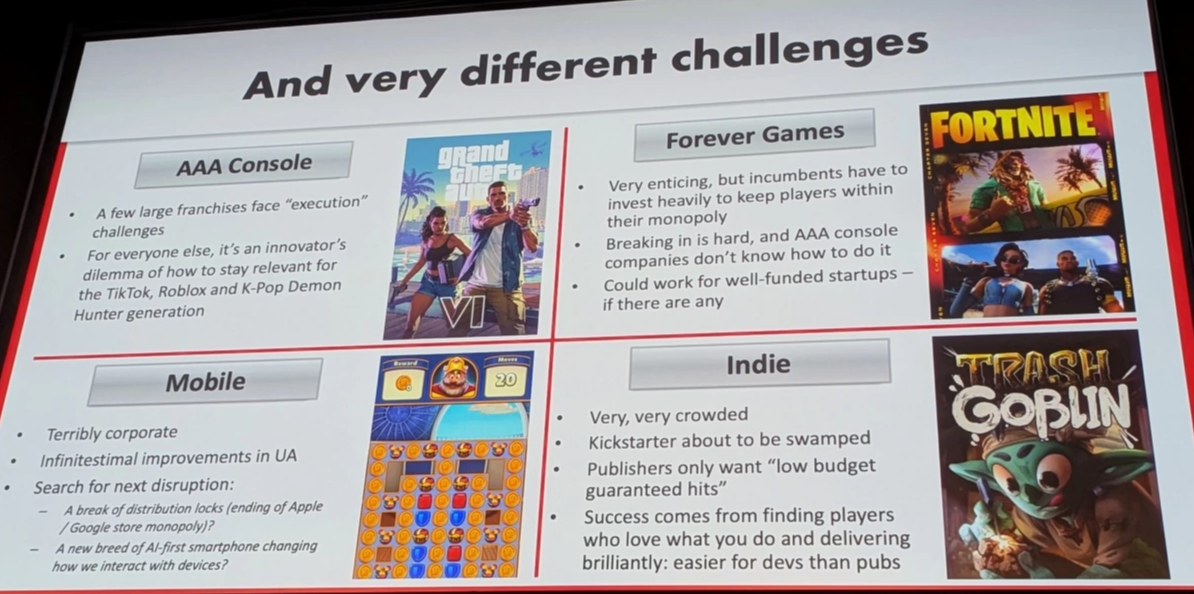
In terms of business models, the development budget for mobile games is usually at $1 million, although more and more projects have recently begun to move towards over $5 million. The discussion stressed, however, thatThe core driving force driving the success of mobile games is marketing rather than playing innovationI don’t know. Risk factors in this sub-area include large-scale advertising for over $50 million. It was noted that the key to the success of these companies was to “be better equipped with user access”. While it was exaggerated to acknowledge that “no innovation in mobile games” was possible, it was argued that it was extremely difficult to achieve innovation in this area. At the same time, it was noted that there were different challenges in various sectors of the industry: for mobile games, “a minimal improvement in the efficiency of user access” and “a far higher marketing cost than the development budget” were the main challenges.

In interviews with the media, British commercial experts have revealed that Chinese distributors perform well in terms of user access, and that some companies have even hired hundreds of people to produce advertising and creative material on a full-time basis, supported by an AI tool to accelerate production.In that market, marketing is even seen by some practitioners as a more important function than development.At the recent RovioCon conference, the famous social media platform for mobile games, Deconstructor of Fun, Mikhail Katekov, listed Chinese distributors as having more games than their Western counterparts, including: commercialization at the beginning of game design – because higher user values support higher user access to budgets.