

Last Friday, Google released the “interactive” world model “Project Genee”, which generates panic in capital markets and declines in stock prices in several game companies, based on the hints.Google stated that its AI technology could generate a 60-second demonstration session at once and had been trained based on open video content.

Google’s promotional video on that day, mispercepted by the market, would impact on existing listed game companies and begin to sell stocks. The game giants Take-Two and Roblox suffered a 10-12 per cent drop in stock prices, while the engine and advertising giant Unity was the most affected, with their share price falling by 20 per cent and re-election in paradise, with the stock price falling by nearly 5 per cent. In response, Chief Executive Officer Matthew Brownberg responded on social media. He referred to the output of Project Genie as “not per se suitable for games that require a consistent, repeatable player experience”. He further stated that the goal of Unity was to help transform these AI concepts into a consistent game.
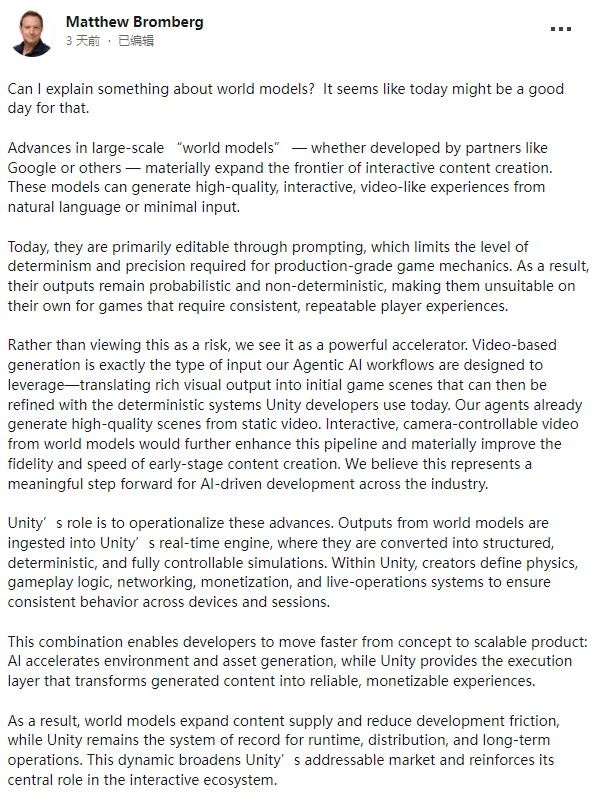
Matthew Bronberg states: “The role of Unity is to put those technological advances into practical application, and the output of the world model will be imported into the Unity real-time engine, where it will be transformed into a structured, definitive, fully manageable simulation environment.” “In Unity, creators define physical rules, game logic, networks, liquidity and real-time operating systems to ensure consistency of behaviour between different equipment and game drawings.” He concluded: “Unity remains the core system for running, distribution and long-term operation. Google’s Genee technology broadens the searchable market for Unity and consolidates its centrality in interactive ecosystems. Tim Sweeney, Managing Director of Epic Games, predicts that: “There will be a sustained leap between engine-centred AI and world-centred AI until they are combined to maximize their effects.”
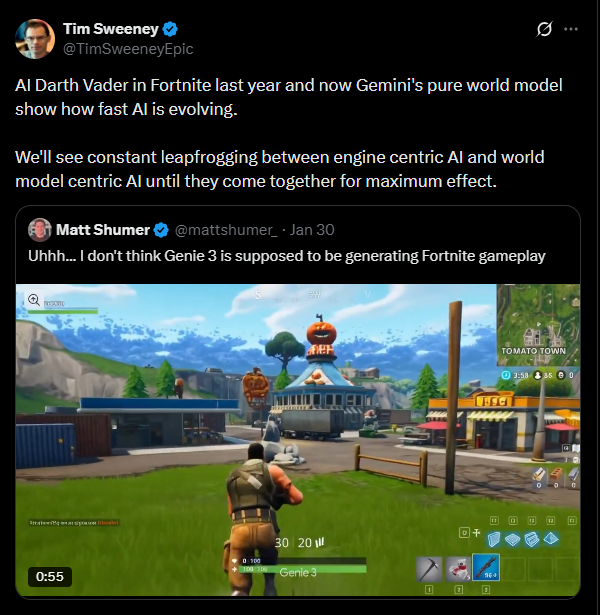
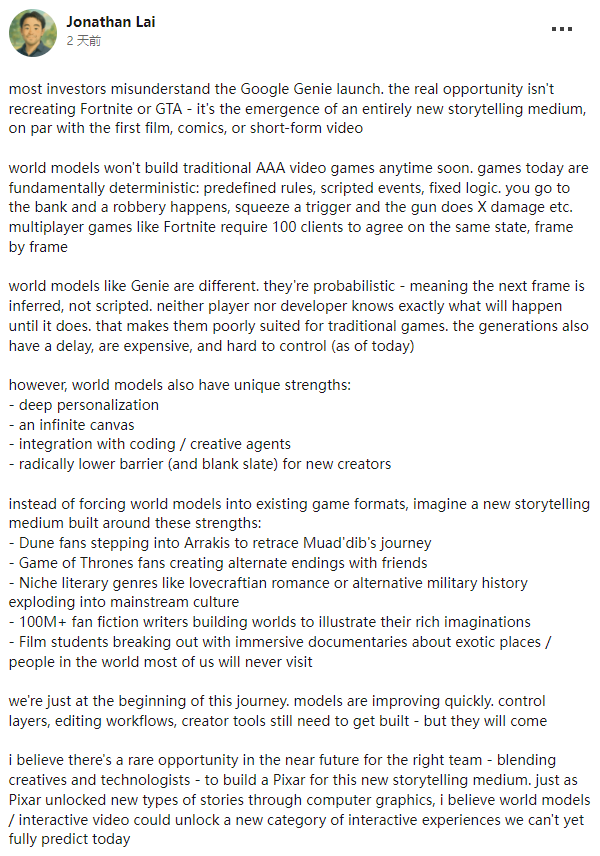
He said: “The Genie model is limited to insufficient and inefficient and expensive memory formats. The ideal evolutionary path is the integration of the world model with the engine, which provides extensive and loosely organized audio-visual and textual knowledge, while the engine provides consistent and reversible data performance and simulation.” Game developers, investors and industry observers on social media also quickly point out that Google demonstrations have little impact on game production in the short term. Jonathan Lai, a general partner of the venture capital company A16Z, stated: “The majority of investors have misunderstood Google Genee, and the model will not soon be used to construct the traditional 3A game. Today’s game is essentially certain, and a world model like Genee is different. They are probabilistic, meaning that the next frame is calculated, not preset scripts. Neither the player nor the developer knew exactly what was going to happen before it happened, making them inappropriate for traditional games.”
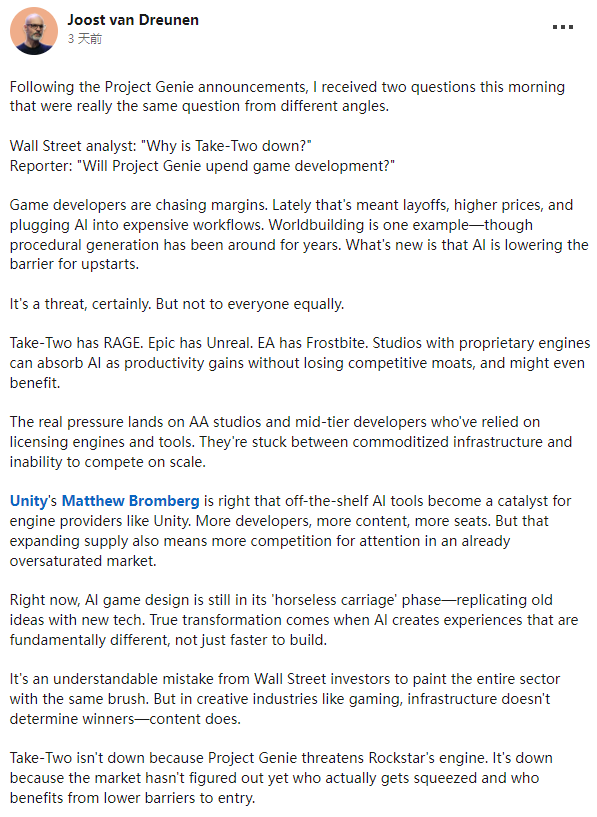
The analyst Joost van Dreunen commented: “Wall Street investors have made an understandable mistake, i.e. an overview of the whole industry. But in creative industries such as video games, it is not infrastructure that determines the winner, but content. The fall in Take-Two share price is not that Project Genie threatens Rockstar’s engine, but because the market has not yet figured out who will actually be squeezed and who will benefit from the lower entry threshold.”
In Finland, the developmenter under the flag of Next Games, Mitchell Smallman, was the best in the industry: “I see now that “the people who consider Google Gene to be important have never played games.” Such posts are already more important than Google Genee.”